


How to Turn Negative Self-Talk into Helpful Thinking (For Kids)
Negative self-talk in children doesn’t always show up in obvious ways. That is why it is important to recognize it in all forms so that unhelpful thoughts can be changed into helpful thinking.
Identifying Negative Self-Talk in Children
So, what is negative self-talk and how does it present in a child? Negative self‑talk is the unkind or discouraging voice in our head that tells us we are not good enough. Children experience negative self‑talk too. You might hear your child say things like, “I’m so dumb,” “I can’t do this,” “I can’t do anything right,” or “I’m never going to get this.” These statements are examples of negative self‑talk. Often it is easy to dismiss these statements as throwaway lines or wanting reassurance, but it can be a sign of something more serious (Martinelli, 2025). When children repeat these thoughts, they may begin to believe them, which can affect their confidence, emotions, and willingness to try new things.
Address and Respond
Sometimes, the instinct as parents is to immediately respond with quick reassurance such as, “No you’re not,” or “Don’t say that about yourself.” And while that comes from a place of love, it can miss what the child is trying to communicate. One way to respond is to acknowledge the feeling, not the words (Cullins, 2026). Let’s look at an example while discovering what the underlying feelings might be:
- Child: “I can’t do anything right.”
- Adult: “I can hear how frustrated you are. You were trying really hard, and it didn’t go the way you wanted.”
This response works because it names the feeling, validates the child’s experience, and opens the door for problem‑solving without reinforcing the negative self‑belief.
When to Consider Counseling
For children, it is normal to experience frustration and to have an “all or nothing” mindset and counseling may be helpful for your child when the child:
- Frequently speaks negatively about themselves
- Struggles with strong emotions or frustration
- Avoids tasks due to fear of failure
- Shows ongoing worry or sadness
In counseling, Cognitive Behavioral Therapy is a helpful approach that supports children in understanding the connection between their thoughts, feelings, and behaviors. CBT teaches children that the thoughts they have about a situation can influence how they feel and how they respond. For children who struggle with negative self‑talk, CBT can be especially effective because it helps them notice unhelpful thoughts and practice changing them into more helpful ones.
Activities for Positive Self-Talk
- Daily Affirmations Mirror: use a mirror in the child’s room and have them write on a mirror with an expo marker 5 amazing things about themselves.
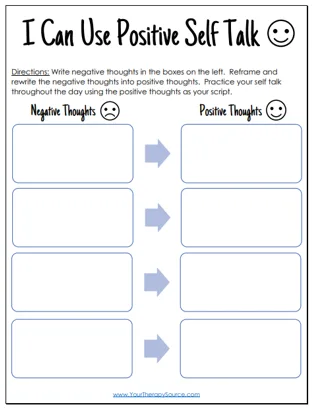
- Work with them to change their own negative self-talk into helpful self-talk. https://www.yourtherapysource.com/wp-content/uploads/2014/06/I-Can-Use-Positive-Self-Talk.pdf
If you’re noticing your child struggling with negative self-talk, you don’t have to navigate it alone. Our counselors are here to help you understand what’s going on and what you can do next. Schedule a free phone consultation, we’d love to talk things through with you and support your family.
References
Cullins, A. (2026, September). 7 Ways To Address Your Child’s Negative Self-Talk. Big Life Journal. https://biglifejournal.com/blogs/blog/negative-self-talk-child-says-dumb-stupid?srsltid=AfmBOor_emfsRenhmKWH9O1eXqQexv0y3Py63CGPQ8l7rwzc2A0RCWv9
Martinelli, K. (2025). How to Help Kids Who Are Too Hard on Themselves. Child Mind Institute. https://childmind.org/article/how-to-help-kids-who-are-too-hard-on-themselves/