


In-Toeing in Children: Causes, Development, and When Physical Therapy Can Help
You may hear your child described as being “pigeon-toed” or notice that their feet turn inward when they walk or run. While this term is commonly used, it can be misleading, because in many cases, the toes themselves aren’t the problem at all. The medical term for this pattern is in-toeing, which simply means the feet point inward instead of straight ahead. This may be noticeable during sitting, standing, walking, or running.
In-toeing is fairly common and typically occurs in otherwise healthy, normally developing children. The good news is that most cases improve naturally over time. Understanding why in-toeing happens and when intervention is helpful can give parents peace of mind and clarity.
Common Causes of In-Toeing by Age
In-toeing can originate from different parts of the leg, depending on a child’s age and stage of development.
- In infants: Metatarsus Adductus
- Metatarsus adductus is a congenital foot shape in which the front of the foot curves inward relative to the heel. This often occurs due to positioning in the womb. Over 90% of cases resolve on their own without any treatment.

- In toddlers: Medial Tibial Torsion
- This is the most common cause of in-toeing overall. The shin bones (tibia) rotate inward, so the knees face forward while the feet turn in. This is considered a normal part of development, and in about 95% of children, the tibias naturally straighten by age five.

- In older children: Femoral Anteversion
- Femoral anteversion occurs when the thigh bone (femur) rotates inward at the hip. At birth, this inward angle is naturally larger and gradually decreases as a child grows. In 99% of cases, femoral anteversion improves on its own by ages 8 to 10 without treatment.
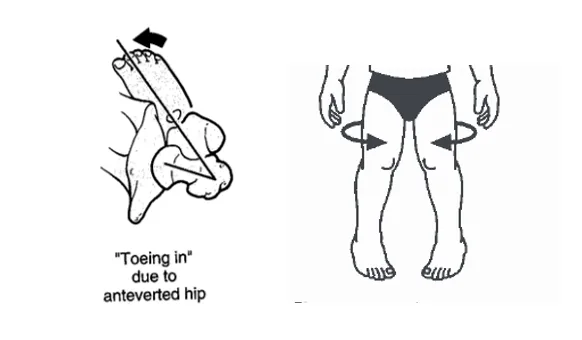
Habits That Can Reinforce In-Toeing
While in-toeing often resolves naturally, certain sitting and movement habits can reinforce inward leg positioning.
Prolonged positions that may contribute to in-toeing include:
- W-sitting, which places the hips in internal rotation and may be associated with underlying core weakness.
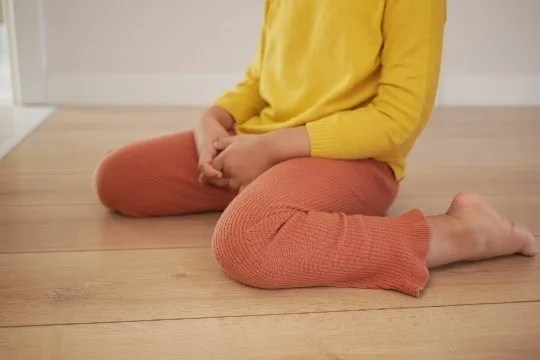
- Sitting with the feet tucked inward under the bottom, which can encourage inward rotation of the shin bones.

Because children’s bones are still developing, they adapt to the stresses placed on them. prolonged positioning in these postures can reinforce inward alignment over time.
What Happens If In-Toeing Is Left Unaddressed?
For most children, in-toeing resolves without intervention. However, when it does not improve or becomes more pronounced, it can contribute to:
- Increased tripping or falling
- Leg, knee, hip, or foot pain
- Inefficient walking or running patterns
- Long-term orthopedic alignment issues
- In these cases, addressing the underlying cause early can help prevent discomfort and functional limitations as a child grows.
When Is Physical Therapy Recommended?
A referral to pediatric physical therapy is recommended if:
- Metatarsus adductus requires early intervention
- Only one leg is affected, causing imbalance
- In-toeing is moderate to severe and impacts gross motor skills or daily activities
- Your child trips frequently or avoids physical activities, gets tired when walking
- Your child reports pain in the hips, knees, or feet
A pediatric physical therapist can evaluate the root cause of in-toeing and provide targeted exercises, positioning strategies, and orthotics (when appropriate) to promote healthier alignment and more efficient movement.
The Bottom Line
In-toeing is common, usually temporary, and most often resolves on its own as part of normal development. However, when it interferes with function, comfort, or participation in activities, early intervention can make a meaningful difference. If you have concerns about your child’s walking pattern or movement development, a physical therapy evaluation can help guide the next steps with confidence. Our team is available to answer your questions. We’d love to hear from you – schedule a free 15-minute phone call with one of our experts.